
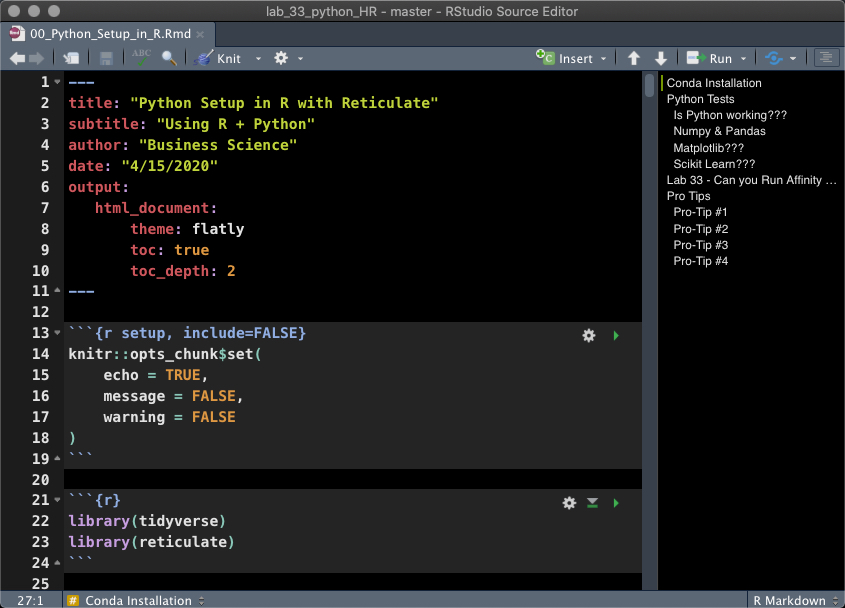
Math extension for Python-Markdown. Now, more and more people are using Rmarkdown and Rstudio to work together in R and Python. I reckon the need to have an improvement for rmarkdown that it can support text highlighting for Python code. See an example below: By filing an issue to this repo, I promise that. I’m trying to use reticulate to run some simple Python code in an RMarkdown document. I’ve found that if Matplotlib is in the conda environment, I get errors when trying to run a python code chunk, but I can run Python from R directly. Here’s a simple example of what I see. Archive of the Python-Markdown HTML Tidy Extension. Markdown is one of the simplest document languages around, that is an open standard and can be converted into.tex.docx.html.pdf, etc. This is the main workhorse of RMarkdown and is very powerful. You can learn Markdown in five (!) minutes Other resources include and this cheat sheet.
11 Feb 2018A few days ago I announced that I had completed the requirements for aPhD in Quantitative Psychology and (maybe more interestingly) that I hadwritten my entire dissertation in Rmarkdown. It was more of a shoutout to @RStudio but the interest in how I did it was exciting.
I defended my dissertation and now have a PhD 🤓 Excited to have thatover with.
My entire dissertation was written in#rstatswith#rmarkdownand got many compliments about the look of the manuscript - grateful to@rstudiofor providing those incredible tools
Several indicated that they’d like to see the process I went through todo this. Questions included:
- How I used RMarkdown for the writing,
- How I formatted it to match the University’s formatting standards,and
- How I worked with my PI while writing with RMarkdown.
I want to answer each of these questions.
Writing with RMarkdown
First, I want to talk about how I went about writing a dissertation inRMarkdown. With the advent of bookdown, a number of people asked ifthat was the tool I used to write my dissertation. Although it is afantastic tool that I have used elsewhere, I wanted the flexibilityof using pure RMarkdown. What I mean by that is that I needed to be ableto integrate Latex formatting files within the system without having tolearn the ins-and-outs of bookdown.
The files I’ll highlight throughout this post can be found atosf.io/753kc. The first, and most importantfile, is the only file you’ll knit. It is the main .Rmd file, in mycase, called MarginalMediation.Rmd. The header YAML in this file lookslike this:
Most of it contains pieces that, if you’ve used somewhat more advancedRMarkdown, you are probably familiar with. These include the title,author, output, bibliography, and nocite. The documentation for this canbe found at RMarkdown’s website. Theother pieces are more rare but still documented as useful YAML optionsin RMarkdown. Among these, documentclass: DissertateUSU is important. This pullsinformation from another file called DissertateUSU.cls, whichultimately controls much of the formatting of the outputted PDF file.This file was made particularly to match the specified formatting for Utah State University (thus the dissertateUSU name) and thus won’t be a perfectfit for all the other universities. My guess is that it is a great starting point for you to match your own situation’s guidelines.
This file has comments throughout to highlight what each section isdoing. It includes the formatting of the title page as well. Using the Params: section of the YAML, the title page is populated with the information put there.It does this as, while knitting, a file called preamble.tex is written through a functionthat is found early in the RMarkdown file. This function comes throughthe dissertateUSU R package on GitHub (download withdevtools::install_github('tysonstanley/dissertateUSU')). Afterinstalling the package, I recommend using the template to get goingusing the approach shown below.
This provides a starting template for the main .Rmd file. It doesn’tinclude the R chunks but you can easily add those. It will looksomething like that below (minus the R chunks but I recommend, as I saidbefore, adding them).
For those familiar with RMarkdown, this starting R chunk (the only onepresent in the template) is important for the remainder of the file.There’s a warning ## Do NOT Remove above thedissertateUSU::preamble_for_title() function. That is the functionthat takes the information from the Params:, places them in apreamble.tex file that fills in the title page information.
In the preceding image, you may have noticed the use of the R chunkoption: child = 'abstract.Rmd'. This means it takes the abstract.Rmdfile in the same directory and knits in within the main .Rmd file. Thatis, the abstract file that I wrote in a separate RMarkdown file, will appear within the main output with the formatting provided in the main.Rmd file.
This general appraoch of using the child = option allows you to writeeach chapter within its own .Rmd file (without worrying too much aboutformatting). This allows editing and error finding to go much more smoothly. You’ll see in the OSF repository that I have my files for all my chapters and the different front matter (abstracts, dedication, acknowledgement, etc.). These are very simple .Rmd files.
This is how the majority of the writing went. I added the writing andother information, including R code (which is printed in theappendices). However, the References, the appendices and the CV at theend of the document took a little bit of hacking to make it work right.
This “hack” required using <div></div> (line 205 in the image) to force thereferences to be printed before the appendices and CV. Further, theappendix files essentially grab the code used in the manuscript and,using echo=TRUE in the R chunks, prints them nicely.

For the references, I used a BibTex file, in this case calledDiss.bib. I used Mendeley as my references manager and then exportedall of my references to the .bib file. This allowed me to use theregular RMarkdown citing while using csl: ref_format.csl (note that itis CSL and not CLS that is used for the formatting) to format thereferences correctly (in my case APA style). This file was downloadedfrom the vast repository of cslfiles. I looked forthe one that fit what I was looking for, downloaded it, and named itref_format.csl and put it in my dissertation’s directory.
Rmarkdown For Python
I’m hoping between this post and the OSF repository, this provides youwith the information to start writing and formatting your dissertationwithin RMarkdown.

Other Things
- For spell checking, I used the built in spell check in RStudio. It wasn’t perfect but worked really well.
- For version control, I used the Open Science Framework (OSF; where I have the files linked). I would have used Git and GitHub had there been collaborators that knew how to use it. This worked well as it provides a simplified version control system while providing tools to share it later.
- I used some simulations in my dissertation. I used a regular script file to write these and run them (using the terminal when possible). I pasted this code within the manuscript toward the end of the writing (when I knew the simulations were done). This allowed me to include them in the appendices more easily.
As a final note, I recommend using RStudio Projects as well. These helpkeep things more organized, especially when it comes to saving andreading in different files.
Formatting the PDF
Rmarkdown For Python Online
Formatting took a lot of Latex code that, honestly, I googled. Itprovided guidance on how to make small changes to the overallformatting. The vast majority of the formatting took place in theDissertateUSU.cls with a little happening in the main .Rmd file.
I don’t have time to go into detail here as most formatting is based onLatex. Many universities have latex style files that you can use, whichcan save you loads of work as the formatting will be done for you inlarge measure.
Working with a Non-useR PI
This may have been the most challenging part of the process. If you havea PI that knows markdown or Latex, then you should be good to go withediting and updating the document using any number of version controlsystems (like Git with GitHub.com). However, a vast numberof senior researchers do not use these, generally using Microsoft’sWord.

This is how my situation was. My PI at first wanted Word documents thatshe could edit using “track changes.” But I convinced her that, given mydesire to have a reproducible workflow and use R throughout all myanalyses, this was an appropriate strategy to avoid inputting mistakes.It took some convincing but I outlined the errors that I was going toavoid using this system:
- My tables would be made automatically and, with minor updating,would be publication ready. No manual input of the numbers in thetable can not only save my time but my PI’s time checking the tablefor little errors. Thus, if my analyses were correct, so were mytables.
- My figures would auto update. If I made a change or fixed an error,I didn’t have to go update it in the manuscript. Instead, it wasautomatically updated in the manuscript itself.
- The manuscript, in general, looks more professional than thoseproduced by Word. The formatting feels sharper, the figures areauto-fitted on the page (as a floating object), and the table andfigure auto-numbering is easy to use and hard to mess up (incontrast to Word which I always struggle not messing up). Inaddition, the formatting is more predictable using this approachthan through Word (e.g., Word tables can randomly go all crazy,leaving cells out or combining them without you asking).
These plus other R related benefits (free, open-source, the helpfulcommunity, etc.) helped me win her over to this approach (and the factthat she is a very reasonable researcher that I’ve enjoyed workingwith).
With this, we agreed that I would produce the PDF files that she couldmark up and return to me with comments.
What Is R Markdown
Notably, another approach we almost took on (that I think works welltoo), is to produce the Word documents without too much formatting usingthe .Rmd files. Then, after the initial round of edits (so that fromthere, there would be fewer edits), use the well formatted PDF files forher to see the look of the pages and make smaller edits and comments.
Overall, this is probably the biggest hang up for most individuals thatare interested in using RMarkdown with a PI that doesn’t use Markdown,Latex or R.
Conclusions
Rmarkdown For Python Programming
This was a quick introduction to how I wrote my dissertation usingRMarkdown. I hope it was helpful to at least get started on the road tousing RMarkdown for your own scientific writing. Please leave feedbackif you have time!
Please enable JavaScript to view the comments powered by Disqus.Related Posts